| |
|
|
|
 |
Protein
Structure Suggests Role as Molecular Adapter
To split and copy DNA during replication, all
cellular organisms use a multicomponent molecular machine known
as the replisome. An essential step in replisome assembly is
the loading of ring-shaped helicases (motor proteins) onto the
separated strands of DNA. Dedicated ATP-fueled proteins regulate
the loading; however, the mechanism by which these proteins recruit
and deposit helicases has remained unclear. To better understand
this process, researchers at the University of California, Berkeley,
recently determined the structure of the ATPase region of DnaC,
a bacterial helicase loader. The structure revealed that DnaC
is a close cousin of DnaA, the protein thought to be responsible
for unwinding DNA. Unexpectedly, the team further found that
DnaC forms a right-handed helix similar to the state adopted
by ATP-bound DnaA. These findings, together with biochemical
studies, implicate DnaC as a molecular adapter that uses ATP-activated
DnaA as a docking site for ensuring that DnaB (the ring-shaped
helicase) is correctly deposited at the onset of replication. Full
story.

Publication about this research: M.L. Mott, J.P.
Erzberger, M.M. Coons, and J.M. Berger, "Structural synergy
and molecular crosstalk between bacterial helicase loaders and
replication initiators," Cell 124,
623 (2009).
Melissa Mott |
Another
Landmark Development in Biological Microscopy at the ALS
The biotech, pharmaceutical, and biofuels industries
all grew out of our ability to understand and then predict how
cells respond to changes in their environment. For example, the
quest to make biofuel production more efficient begins with understanding
how the cells that carry out fermentation deal with increasingly
toxic concentrations of alcohol or butanol, taking advantage
of this knowledge to guide the development of organisms with
increased tolerance toward these molecules. Microscopy is a key
technology in such work, in particular, high-resolution three-dimensional
methods such as soft x-ray tomography. The establishment of the
National Center for X-Ray Tomography (NCXT) and the construction
of XM-2 firmly put the ALS on the map as a premier facility for
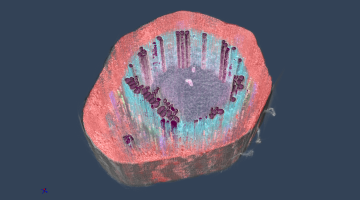
imaging cells. Recently, the ALS became home to a completely
new bio-imaging method: cryogenic, high-numerical-aperture light
microscopy.
Developed
by Mark Le Gros and Carolyn Larabell of the NCXT, this new microscope
satisfies a long-standing need in cellular imaging. Now, for the
first time, it is possible to image a whole, hydrated cell at high
spatial resolution using both light and soft x rays. Correlation
of the two data sets allows visualization of detailed cellular
structure (x rays) together with the location of molecules tagged
with a fluorescent label (light). The combination of these two
pieces of knowledge is the "Holy Grail" of cell biology
and answers the fundamental questions of who, what, where, and
when. In other words, which molecules are interacting, and where
and when do these interactions occur in the cell. This is a very
exciting development in the world of cellular imaging, with the
ALS being the only facility in the world with this capability.
This new multimodal imaging resource has already begun to be used
to address a wide range of highly topical questions, ranging from
the design of new drugs to fight malaria and fungal infections
to understanding where biodiesel is stored in algae. The possible
applications of this new technique are virtually limitless, and
it opens up a new chapter in biological research at the ALS.
The new cryo-light microscope used in this work
is described in detail in the paper, "High aperture cryogenic
light microscopy," by M.A. Le Gros, G. McDermott, M. Uchida,
C.G. Knoechel, and C.A. Larabell, to be published in the July 2009
issue of the Journal of Microscopy.
Gerry McDermott |
Call
for General User Proposals: Upcoming Deadlines
The User Services Office is accepting general
user proposals from scientists who wish to conduct research at
the ALS in the next cycle.

PROPOSAL SUBMISSION DEADLINE (physical sciences
beamlines):
Cycle: January 2010–June 2010
Deadline: July 15, 2009
PROPOSAL SUBMISSION DEADLINE (structural biology/biological
SAXS):
Cycle: October 2009–December 2009
Deadline: August 15, 2009.
NEW PROPOSALS: To submit a new proposal, please
complete the appropriate online
form.
ACTIVE PROPOSALS: Proposals for physical sciences beamlines are
considered active and may be renewed for up to three, six-month
cycles after the initial submission. After a total of four cycles,
a new proposal must be submitted. If you have an active proposal
for which you would like to request beam time during the January
2010–June 2010 cycle, please submit a Proposal
Renewal Form.
The following resources have been recently updated and are available
for further information:
General
information on the proposal process
Advice
on what to include in the scientific case
Beamline
information
Proposal
scores for the current cycle
The proposal form now includes a section on publications
from previous ALS work. The publications will be pre-filled automatically
from the ALS publication database by searching for the principal
investigator's name. Please make sure your publications are entered
into our database.
alsproposals |
UEC
Corner: ALS Users' Meeting Important Dates
The 16th annual ALS Users' Meeting is just
a few months away: October 15–17, 2009. As in 2007, this
year's meeting will be held jointly with The Molecular Foundry,
with joint plenary and poster sessions, workshops, and a banquet.
Information will be posted on the Users'
Meeting Web site as it becomes available.
WORKSHOPS:
This year's meeting will have a primary focus on research to further
the United States' and the world's energy agenda. Workshops cover
that theme and a broad spectrum of other issues, including detectors;
x-ray diffraction; graphene; influenza; nanomagnetism; next-generation
light sources; numerical modeling; quantum systems, clusters, and
assembled materials; spectroscopy; tailored materials; and polymers.
AWARDS: Nominations for the Shirley (Science),
Halbach (Instrumentation), and Renner (Service) Awards will accepted
until Monday, August 31, 2009. This year's nomination process will
be a bit different than in previous years. Please check the Users'
Meeting Web site in July for details.
POSTERS: The deadline for poster abstract submissions
is Monday, August 31, 2009. Students submitting posters have the
opportunity to compete for three poster awards, with the winner
being given an opportunity to speak at the Friday morning session.
LODGING: The Berkeley Lab Guest House is nearing
completion, and we expect that it will be ready to accept guests
by the time of the meeting. However, reservations are not being
accepted just yet. Check the above link frequently if you'd like
to be one of the first guests. A block of rooms has also been reserved
at the Hotel Durant.
UEC ELECTIONS: Finally, the ALS Users' Executive
Committee will be electing three new members and one student representative
this fall. Nominations will be accepted until October 15, 2009,
and voting will begin on October 16, 2009, on the second day of
the meeting. Nomination instructions will be provided on the ALS
Users' Meeting Web site in July.
Ken Goldberg (UEC Chair)
Yayoi Takamura (Users' Meeting Co-Chair)
David Osborn (Users' Meeting Co-Chair) |
Update
on the Guest House at Berkeley Lab
Located within a short walk of the ALS and
the cafeteria, the 57-room guest house will provide 70 beds in
single- and double-occupancy rooms, and will include a main lobby,
lounge/kitchenette area, laundry facilities, vending areas, and
an outdoor patio. All rooms will have a refrigerator and free
wireless Internet access.

Construction of the guest house is nearing completion,
with electrical and air-conditioning commissioning starting this
week. Furniture has been ordered and will be fitted in August,
to be followed by further commissioning and staff training. An
interim general manager is in place and work on the Web site is
progressing. The opening date is currently being negotiated with
the operating contractor and is likely to be the first week of
October. The rates for staying at the guest house will be set within
the next couple of weeks and will depend on the size and occupancy
of the room with a slight premium for a bay view. The operator
can now take reservations for groups of 10 rooms or more. Starting
September 1, 2009, the operator will take reservations for individuals
or groups booking fewer than 10 rooms. Reservations can be made
by contacting Megan Troup (510-643-2454).
Sue Bailey |
Job
Opportunity: ALS Writer-Editor
The Advanced Light Source seeks a dynamic,
creative writer to create and edit printed documents and electronic
media to communicate the mission and achievements of the ALS.
The writer will support the scientific and user programs of the
ALS through the production of publications by working with scientists
and technical staff to create visual displays, presentation materials,
and grant proposals.
A primary role is to plan, edit, produce, and
distribute a monthly email newsletter designed to keep ALS researchers
and other interested parties informed about developments at the
ALS. It will require the incumbent to apply broad knowledge of
ALS research programs, scientific and engineering concepts, and
Berkeley Lab's publication processes to communicate technical and
nontechnical information for publication or verbal presentation.
Will use Web 2.0 and social networking technologies to expand readership
and to develop new audiences.

Read more at the official
job posting. |
_________________________________________________ |
Operations |
|
|
For the user runs
from May 13 to June 15, the beam reliability [(time scheduled – time
lost)/time scheduled)] was 96.0%. For this period, the mean time
between failures (MTBF) was 38.9 hours, and the mean time to recovery
(MTTR) was 96 minutes. There were no significant interruptions.
During this period we set a new record for
continuous hours of light provided to users in top-off mode:
95 continuous hours of light were provided to users from June
4 to June 7.
More detailed information on reliability is available
on the ALS reliability bulletin board, which is located in the
hallway between the ALS and the control room in Building 80. Questions
about beam reliability should be directed to David Richardson (x4376
).
Long-term and weekly operations
schedules are available here.
Requests for special operations use of the "scrubbing" shift
should be sent to Rick Bloemhard (ALS-CR@lbl.gov,
x4738) by 1:00 p.m. Friday. View the ring status in real time here. |
|
 |
|