Ribosomes Ready for Extreme Close-Up
|
The ribosome is a multicomponent machine that, in bacteria, is
21 nm in diameter. Given the large size of the ribosome, it has
been difficult to determine how it works at a molecular level.
To provide a complete picture of the protein synthesis cycle, many
groups have been striving to make an atomic-resolution "movie" of
the intact ribosome synthesizing a protein. Cate et al. have determined
the first "frames" of this movie by solving the atomic-resolution
structures of two intact ribosomes from the model organism, Escherichia
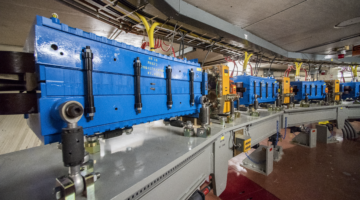
coli. To determine the ribosome structures, they used x-ray
crystallography at ALS Beamlines 8.3.1 and 12.3.1.
The researchers' close proximity to the ALS was critical for optimizing
x-ray diffraction from the fragile ribosomes that they had crystallized.
| |
 |
| |
|
|
Schematic of protein
synthesis. The intact ribosome (lower left) reads messenger
RNA (long strand at bottom) to synthesize a protein (the
strand growing from the top of the ribosome) out of amino
acids brought by transfer RNAs (upper right). |
The ribosome crystals happened to contain a repeating unit of
two ribosomes, which turned out to be an unexpected boon. Each
of the two ribosomes adopted a different conformation, providing
clues as to how the ribosome moves along messenger RNA (mRNA),
the genetic template for protein synthesis. Comparison of the two
ribosome structures revealed movement of the "head" of
the small ribosomal subunit that the researchers think helps to
complete one step along the mRNA, a process called "translocation." Using
models and lower-resolution structures of the ribosome, the group
proposed a sequence of steps in translocation that finishes with
the swiveling of the small subunit head to allow the mRNA and the
transfer RNAs to move by one step. Swiveling of the head may be
driven by a protein enzyme called Elongation Factor G (EF-G), which
burns one guanosine triphosphate (GTP) molecule to catalyze the
stepping along the mRNA.
Swiveling of the head of the small ribosomal subunit within
the intact ribosome. Left: View of the intact ribosome showing
the small subunit (dark and light blue) and large subunit (grey
and magenta). Right: Swiveling of the head of the small ribosomal
subunit (blue difference vectors) determined from the two ribosome
structures.
A second intriguing finding from comparison of the two structures
is the mode of long-range movements within the ribosome. The researchers
were able to identify three long-range motions of 15 Å or
more that are concentrated in standard RNA helices within the ribosomal
RNA. The researchers think that these may be molecular versions
of torsion springs that absorb the strains induced by the rotation
of the head domain. The fact that similar neck-helix dynamics have
also been identified by biochemical means in human ribosomes suggests
that the role of these helices is conserved in all forms of life.
Twisting of the neck helix within the small subunit allows swiveling
of the head domain. One ribosome is colored red, while the other
is blue.
Finally, the researchers found that the interface between the
two ribosomal subunits, the 30S and 50S subunits in bacteria,
to a large extent consists of salt water. The number of direct interactions
between the two subunits, which are primarily RNA, was much lower
than expected. This may explain why ribosome function is incredibly
sensitive to the salts in the solution around it.
Many commonly used antibiotics target the function of the intact
ribosome. Now that intact ribosome crystals that diffract x rays
to high resolution have been obtained, the researchers are now
working to probe the structural basis for how these antibiotics
work. In particular, they are probing how different classes of
antibiotic affect three steps of translation. One class of antibiotic
blocks translation initiation, whereas a second class degrades
accurate mRNA decoding or slows translocation. Yet a third specifically
targets translocation by a different mechanism. This future work
may potentially open new avenues for antibiotic design.
Research conducted by B.S. Schuwirth (University of California,
Berkeley, and Free University of Berlin, Germany); M.A. Borovinskaya,
A. Vila-Sanjurjo, and J.M. Holton (Berkeley Lab);
C.W. Hau and Wen Zhang (University of California,Berkeley); and
Jamie H. Doudna Cate (University of California, Berkeley, and
Berkeley Lab).
Research funding: National Institutes of Health and U.S. Department
of Energy, Office of Basic Energy Sciences (BES). Operation of
the ALS is supported by BES.
Publication about this research: B.S. Schuwirth, M.A. Borovinskaya,
C.W. Hau, W. Zhang, A. Vila-Sanjurjo, J.M. Holton, and J.H.D. Cate, "Structures
of the bacterial ribosome at 3.5 Å resolution," Science 310,
827 (2005).
ALSNews
Vol. 264, April 26, 2006 |