|
Ferromagnetic wires of nanometer sizes are
considered to be key components in future spintronic applications
for novel classes of magnetic storage devices. One example is
the concept of a racetrack
memory, where instead of a spinning disk in which individual
information bits fly by a read head, magnetic domain walls acting
as information units are pushed by spin currents along a magnetic
wire until they are read out by a stationary head. One of the fundamental
issues for such schemes is the precise control of domain-wall motion,
which in turn is directly linked to the reproducibility of domain-wall
propagation, pinning, and depinning.
To locally control the position and the motion of a domain wall,
it is common to introduce artificial topological imperfections,
such as notches or antinotches, into the wire. The potential created
around such a notch is sufficient to trap and release the domain
wall in a controlled way. Although a wealth of information has
already been experimentally and theoretically obtained, the fundamental
question of under what conditions, if any, the domain-wall dynamics
in the vicinity of artificial notches can be fully deterministic
has not been addressed so far.
The Berkeley–Hamburg group used the soft x-ray microscope
at ALS Beamline
6.1.2 for an in-depth investigation of the statistical behavior
of the domain wall depinning field at a single notch in permalloy
nanowires with different wire widths (w), notch depths (Nd), and
film thicknesses (t). Magnetic images based on magnetic circular
dichroism contrast with a spatial resolution of better than 25
nm were recorded as an applied magnetic field was gradually increased
in steps. In a magnetically saturated wire (only one domain in
the wire), increasing the field successively nucleates a second
domain (and hence a domain wall) at one end of the wire, propagates
the wall down the wire until it becomes pinned at a notch, depins
the wall, and drives the wall to the other end of the wire.
Top: Typical SEM image of a 50-nm thick nanowire with
a width of 150 nm together with enlarged notch patterns with
notch depths of about 30%
and 50% of the wire width. Bottom: Three representative image
sequences of magnetic-domain wall evolution as an applied magnetic
field was gradually increased in steps for wire widths of w = 150 nm
(left), 250 nm (center), and 450 nm (right). The images illustrate
the nucleation of the domain wall in the bulb at the left end
of the wire and its subsequent motion toward the right end. The
magnetic field at each step of the domain-wall evolution pattern
is indicated.
The stochastic nature of the domain-wall depinning field for different
notch depths and wire widths was systematically investigated by
determination of the field distribution from depinning events in
experiments repeated at least 40 times for each wire. For the first
time, these results clearly showed that the domain-wall depinning
field exhibits stochastic behavior and the stochastic nature depends
considerably on the wire width and the notch depth. A thorough
analysis of the data allowed the researchers to conclude that it
is the multiplicity of domain-wall types (transverse, vortex, etc.)
generated in the vicinity of a notch that is responsible for the
observed dependence of the stochastic nature of the domain-wall
depinning field on the wire width and the notch depth.
Domain-wall evolution patterns taken from three consecutive
experiments under identical measurement conditions for wires
of width w = 150,
250, and 450 nm. The color scale represents the field when
a domain wall reaches the notch and is pinned and when the wall
is depinned at a notch. A hint of the width dependence of the variation
in the depinning field is already evident. Analysis of 40 measurements
for each of several wires with different wire widths and notch
depths demonstrates the domain wall motion does have a stochastic nature
but that it depends on the width and depth, thereby providing
a path to minimizing this behavior.
While at first glance these findings seem to discourage a successful
implementation of devices driven by domain walls, it also shows
that a proper geometrical design of the wires could limit the domain-wall
types and hence minimize the stochastic behavior of the domain-wall-depinning
process, which should be easy to achieve with state-of-the-art
patterning and fabrication tools.
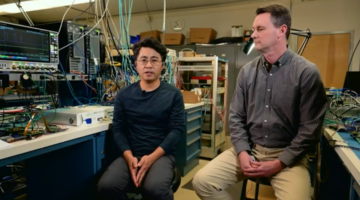
Mi-Young Im and Peter Fischer of Berkeley Lab’s
Center for X-Ray Optics at the XM-1 full-field soft x-ray transmission
microscope at ALS Beamline 6.1.2.
Research conducted by M.-Y. Im and P. Fischer (Center for X-Ray
Optics, Berkeley Lab); L. Bocklage and G. Meier (University
of Hamburg, Germany).
Research funding: U.S. Department of Energy, Office of Basic Energy
Sciences (BES) and the Deutsche Forschungsgemeinschaft. Operation
of the ALS is supported by BES.
Publication about this research: M.-Y. Im, L. Bocklage, P. Fischer,
and G. Meier, “Direct Observation of Stochastic Domain-Wall
Depinning in Magnetic Nanowires,” Phys. Rev. Lett. 102,
147204 (2009). |