Cartoon showing ATL as bridge between base repair and nucleotide
excision rrepair, two DNA repair pathways that were previously
thought to function independently from each other. If ATLs are eventually
found in humans, these results could significantly aid the development of
more effective cancer treatments. [Figure courtesy of J.L. Tubbs, Scripps
Research Institute.]
The research team started with diffraction data collected at the ALS (SIBYLS
Beamline 12.3.1) and SSRL to determine structures for ATL (Atl1) without
damage and with either endogenous or cigarette-smoke-derived damage. These
structures, the first for any ATL, show that although Atl1 looks similar
to the parts of alkyltransferase (AGT) where DNA binding and alkyl transfer
occur, it has certain distinguishing features. Like AGT, Atl1 flips (transfers)
a nucleotide from the DNA double helix to its active site to access damaged
nucleotides. But unlike AGT and most other known DNA nucleotide-flipping
proteins, this flipping is not connected to any type of enzymatic activity
or catalysis. In addition, Atl1 has a larger binding pocket to accommodate
a wider variety of damaged DNA nucleotides, including those that are too
big to fit the AGT binding pocket, and Atl1 creates a bigger bend in DNA
than AGT upon binding DNA.

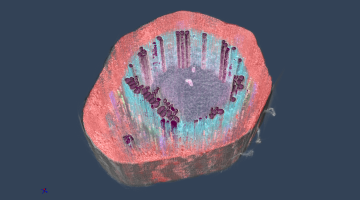
Crystal structure for Atl1 (magenta) bound to DNA containing alkylation
damage associated with O6-methylguanine (yellow). The ATL binding
site (center, magenta) is drawn as a ball-and-stick representation.
Typically, there are two general DNA repair mechanisms for DNA alkylation
damage, direct damage reversal and base excision repair (BER).
For example, base alkylation damage is repaired by direct damage
reversal proteins like AGT or by lesion-specific DNA enzymes (glycosylases)
that initiate the BER pathway by excising bases. In contrast, there
is another, more versatile DNA repair pathway called nucleotide excision
repair (NER) that works
by removing bulkier DNA helix-distorting lesions by excising a
DNA patch containing a damaged base. Generally, NER poorly recognizes
the kinds of alkylation damage repaired by alkyltransferases and is therefore
not usually expected to be active in these cases.
Through a series of genetic and biochemical experiments, however, the researchers
unexpectedly discovered that Atl1 function is linked to the NER pathway
of DNA repair after all. It turns out that ATL bridges two DNA repair pathways
(base repair and nucleotide excision repair) that were previously thought
to function independently of each other. The researchers' combined results
reveal a general mechanism in which ATL binds weakly distorting lesions
(base damage) in a manner comparable to AGT and BER glycosylases and recruits
NER-associated proteins by sculpting the weakly distorting alkylation damage
into a bulky lesion that is channeled into the NER pathway.
By mapping conservation of amino acid sequences between their ATL and sequences
in other ATLs, the researchers realized that their structures could also
characterize the other ATLs. Analysis of lesion-binding site conservation
based on the new structures led to identification of new ATLs in ancestral
archaea (unicellular microorganisms without nuclei or organelles) as well
as the first ATL discovered in any multicellular organism, a sea anemone.
Together with already known ATLs, this discovery indicates that ATL interactions
are ancestral to present-day repair pathways in all domains of life. Therefore,
although no ATL has yet been discovered in humans, it is likely that an
ATL or similar protein exists in humans, thereby opening the door to improved
cancer chemotherapy based on alkylating agents and repair pathway control
Research conducted by J.L. Tubbs, A.S. Arvai, and M.D. Kroeger
(The Scripps Research Institute); S. Kanugula and A.E. Pegg (Pennsylvania
State University); V. Latypov, A. Butt, A. Marriott, A.J. Watson, B. Verbeek,
G. McGown, M. Thorncroft, and G.P. Margison (University of Manchester,
UK); M. Melikishvili, M.G. Fried (University of Kentucky); R. Kraehenbuehl
and O. Fleck (Bangor University, UK); M.F. Santibanez-Koref (Newcastle
University, UK); C. Millington and D.M. Williams (University of Sheffield,
UK); L.A. Peterson (University of Minnesota); and J.A. Tainer (The Scripps
Research Institute and Berkeley Lab).
Research funding: National Institutes of Heath, The Skaggs Institute for
Chemical Biology, North West Cancer Research Fund, Cancer Research-UK and
CHEMORES. Operation of the ALS and of SSRL is supported by the U.S. Department
of Energy, Office of Basic Energy Sciences.
Publication about this research: J.L. Tubbs, V. Latypov, S. Kanugula, A.
Butt, M. Melikishvili, R. Kraehenbuehl, O. Fleck, A. Marriott,
A.J. Watson, B. Verbeek, G. McGown, M. Thorncroft, M.F. Santibanez-Koref,
C. Millington, A.S. Arvai, M.D. Kroeger, L.A. Peterson, D.M. Williams,
M.G. Fried, G.P. Margison, A.E. Pegg, and J.A. Tainer, "Flipping of
alkylated DNA damage bridges base and nucleotide excision repair." Nature 459,
808 (2009). |